

Iversun 6 mg vs 12 mg: Ivermectin Strengths, Product Labels, and Common Use Questions

Iversun 6 mg vs 12 mg is mainly a comparison of tablet strength, not two different active medicines: both contain ivermectin, an antiparasitic medicine. The manufacturer, Sunrise Remedies, lists Iversun as ivermectin dispersible tablets in both 6 mg and 12 mg strengths. A 12 mg tablet contains twice as much ivermectin as a 6 mg tablet, but that does not mean it is automatically the better or more appropriate option. Ivermectin dosing for recognised parasitic infections can depend on body weight, the infection being treated, the product label, and clinical circumstances. This guide explains what the two strengths mean, how to read the product label, why tablet strength should not be confused with the required dose, and which common use and safety questions are worth discussing with a healthcare professional.
What Is the Difference Between Iversun 6 mg and 12 mg?
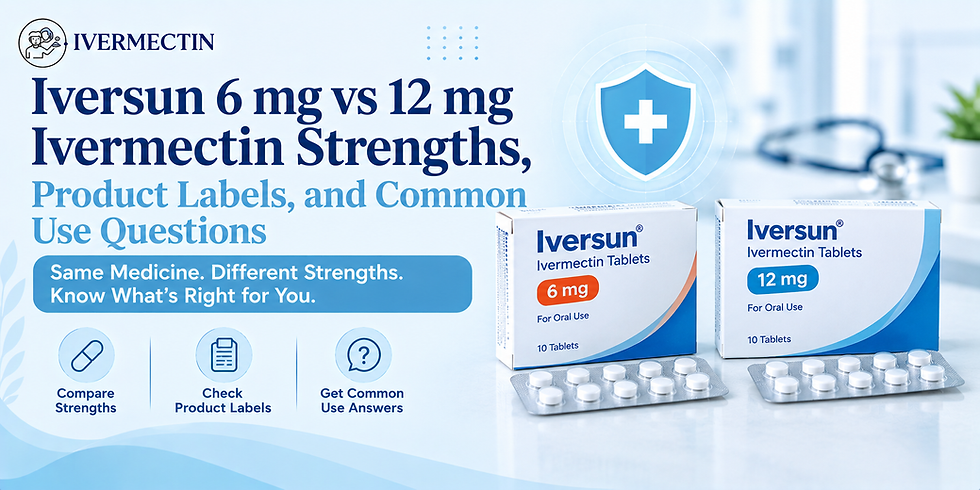
The straightforward difference is the amount of ivermectin in each tablet. According to Sunrise Remedies, Iversun is available as ivermectin dispersible tablets containing either 6 mg or 12 mg.
That means:
Iversun 6 mg contains 6 mg of ivermectin per tablet.
Iversun 12 mg contains 12 mg of ivermectin per tablet.
One 12 mg tablet therefore contains twice the active ingredient present in one 6 mg tablet.
That comparison describes strength only. It does not establish which strength a particular person should take.
Why does tablet strength matter?
Tablet strength tells you how much active medicine is contained in a tablet. The actual dose needed for a recognised ivermectin indication may instead be calculated according to body weight and the condition being treated.
For example, the official ivermectin prescribing information for US-labelled oral ivermectin uses approximately 200 micrograms per kilogram (mcg/kg) for strongyloidiasis and approximately 150 mcg/kg for onchocerciasis. These figures illustrate why choosing a tablet simply because it says “6 mg” or “12 mg” is not a reliable way to determine an individual dose.
Iversun 12 mg is stronger per tablet than Iversun 6 mg, but “stronger” does not mean “better.” The appropriate total ivermectin dose depends on the indication, body weight and applicable prescribing guidance.
Iversun 6 mg vs 12 mg at a glance
Feature | Iversun 6 mg | Iversun 12 mg |
Active ingredient | Ivermectin | Ivermectin |
Strength per tablet | 6 mg | 12 mg |
Relative amount | Lower-strength tablet | Contains twice the ivermectin of a 6 mg tablet |
Dosage form listed by manufacturer | Dispersible tablet | Dispersible tablet |
Manufacturer | Sunrise Remedies | Sunrise Remedies |
Does strength alone determine the correct dose? | No | No |
Product information should always be checked on the actual pack or dispensing label because formulations, labelling and availability can differ between markets.
How Should You Read an Iversun or Ivermectin Product Label?
Start with the active ingredient and strength, then check the dosage form, manufacturer, batch information, expiry date and directions supplied with the medicine. Do not rely only on the brand name or the appearance of the tablet.
Active ingredient and strength
“Ivermectin 6 mg” means each labelled tablet provides 6 milligrams of ivermectin. “Ivermectin 12 mg” means each provides 12 milligrams.
This distinction becomes particularly important if someone changes between tablet strengths. The number of tablets cannot automatically remain the same when the amount of drug in each tablet changes.
Dosage form
Sunrise Remedies describes Iversun 6 mg and 12 mg as ivermectin dispersible products. A manufacturer certificate of analysis for an Iversun 12 batch also identifies the product as “Ivermectin Dispersible Tablets 12 mg.”
That product-specific information should not automatically be applied to every ivermectin brand. Different manufacturers and countries can market ivermectin with different strengths, dosage forms, packaging and approved labelling.
Manufacturer, batch and expiry information
The manufacturer identifies Iversun as a Sunrise Remedies brand. When checking a medicine pack, also look for batch or lot identification, manufacturing and expiry information, storage instructions, and intact packaging.
If the packaging looks altered, the strength is unclear, or the information on the blister and outer box does not agree, a pharmacist should check the product before it is used.
Does Iversun 12 mg Work Better Than Iversun 6 mg?
Not simply because it contains more ivermectin. A 12 mg tablet provides twice the drug per tablet, but treatment effectiveness depends on whether the total dose and treatment plan are appropriate for the particular infection and patient, rather than on choosing the highest available tablet strength.
This is an important distinction with weight-based medicines. For recognised oral ivermectin indications, official labels may specify doses in mcg/kg rather than saying that everyone should take the same tablet strength.
What can influence an ivermectin treatment decision?
Factor | Why it matters |
Confirmed or suspected condition | Different parasitic infections may require different treatment approaches |
Body weight | Some recognised ivermectin doses are calculated in mcg/kg |
Tablet strength | Determines how much ivermectin is present in each tablet |
Other medicines | Potential interactions and treatment considerations may need review |
Pregnancy or breastfeeding | Requires individual medical assessment |
Other health conditions | May affect whether ivermectin or another approach is suitable |
Local product label | Approved indications and instructions can vary by jurisdiction |
This is also why a dose used by another person should not be treated as a template. Two people may have different diagnoses, weights, medicines and clinical risks.
What Is Ivermectin Commonly Used For?
Ivermectin is an antiparasitic medicine used for specific infections caused by susceptible parasites. Recognised uses depend on the formulation and jurisdiction, so the applicable product information matters.
Strongyloidiasis
Strongyloidiasis is caused by the parasitic roundworm Strongyloides stercoralis. Oral ivermectin is an established treatment, and the World Health Organization guidance on strongyloidiasis identifies oral ivermectin as the standard treatment for chronic S. stercoralis infection.
WHO's 2024 public-health guideline also recommends single-dose ivermectin at 200 mcg/kg for certain mass-drug-administration programmes in endemic settings. That recommendation concerns population-level preventive chemotherapy and is not a replacement for individual clinical diagnosis and treatment.
Onchocerciasis
Onchocerciasis, sometimes called river blindness, is another parasitic infection for which oral ivermectin has an established role. US prescribing information describes a weight-based dose of approximately 150 mcg/kg.
Importantly, ivermectin acts against developing forms of the parasite rather than reliably killing adult Onchocerca worms. This helps explain why repeat treatment can be required in appropriate clinical programmes.
What about scabies and other uses?
Ivermectin is also used in clinical practice for some other parasitic conditions, including scabies, but the approved status, formulation and recommended regimen can differ by country. MedlinePlus notes that ivermectin may be prescribed for conditions including scabies and certain lice infestations.
That does not mean every Iversun strength or every oral ivermectin product is labelled for every parasitic condition. Check the locally applicable product information and professional advice rather than assuming that one brand's list of uses applies universally.
Why Can’t You Choose Between Iversun 6 mg and 12 mg by Strength Alone?
Because the milligram number on the box describes the tablet, not necessarily the dose a particular person needs. For some recognised ivermectin indications, dosing is based on body weight, so clinicians work from the required total dose rather than simply selecting the “strongest” tablet.
An official ivermectin label that includes both 3 mg and 6 mg tablets illustrates this principle. For strongyloidiasis, it provides weight-based tablet quantities intended to deliver approximately 200 mcg/kg; for onchocerciasis, the target is approximately 150 mcg/kg.
This also explains why comparing the number of tablets between products can be misleading. Two tablets are not necessarily the same dose if the tablets have different strengths.
A pharmacist or prescriber can also check whether a tablet is intended to be divided or dispersed. Do not assume that every tablet can be split simply because a calculated amount appears to require a fraction of a tablet.
What Should You Know Before Taking Ivermectin?
Before taking ivermectin, make sure the condition being treated and the intended dose have been appropriately established. A healthcare professional should also know about other medicines, supplements, allergies and relevant medical circumstances.
The MedlinePlus ivermectin medicine guide advises patients to tell their healthcare professional about prescription and non-prescription medicines, vitamins, supplements and herbal products they use.
Do not take more ivermectin, take it more frequently, or repeat treatment simply because symptoms continue. Depending on the infection, persistent symptoms can require reassessment, testing or a different treatment plan rather than additional unsupervised doses.
Ivermectin products intended for animals should not be substituted for human medicines. Veterinary formulations can differ in concentration and formulation and are not labelled for human use.
Safety and When to Seek Medical Advice
Ivermectin can cause unwanted effects, and the symptoms experienced may also be influenced by the infection being treated. Medical advice is particularly important if symptoms are severe, unusual or worsening after treatment.
Seek prompt medical attention for signs of a serious allergic reaction, such as difficulty breathing or significant swelling, or for severe neurological symptoms such as marked confusion, loss of coordination, unusual sleepiness or seizures. The US ivermectin label describes rare post-marketing reports of serious neurological events.
Speak with a healthcare professional before using ivermectin if you are pregnant or breastfeeding, have important underlying medical conditions, take other medicines, or are uncertain about the diagnosis. Children and people being treated for infections acquired in regions where multiple parasites may occur can require additional clinical assessment.
Most importantly, do not use the difference between 6 mg and 12 mg as a self-dosing rule. The label strength is only one part of a safe treatment decision.
Conclusion
The central point in Iversun 6 mg vs 12 mg is simple: both products contain ivermectin, while the 12 mg tablet contains twice as much active ingredient per tablet as the 6 mg strength. That difference can affect how a prescribed total dose is supplied, but it does not make 12 mg inherently more effective or appropriate. Ivermectin treatment can depend on the parasite, body weight, local product label and individual clinical circumstances.
Check the actual product packaging and follow qualified medical or pharmacy advice rather than choosing or changing strengths yourself. This information is educational and does not replace diagnosis, prescribing advice or an individual treatment plan.


Frequently Asked Questions
1. Is Iversun 12 mg stronger than Iversun 6 mg?
Yes. Iversun 12 mg contains twice as much ivermectin per tablet as Iversun 6 mg. That makes it a higher-strength tablet, but it does not mean 12 mg is automatically the correct or more effective dose for a particular person.
2. Are Iversun 6 mg and 12 mg the same medicine?
They contain the same active ingredient, ivermectin, but in different amounts per tablet. Sunrise Remedies lists both as ivermectin dispersible products. The appropriate strength or tablet quantity depends on the prescribed treatment rather than the brand name alone.
3. Can I take two Iversun 6 mg tablets instead of one 12 mg tablet?
Mathematically, two 6 mg tablets contain 12 mg of ivermectin, but that does not establish that substitution is appropriate for you. Formulation, prescription instructions and the required total dose still matter. Confirm any strength substitution with a pharmacist or prescriber.
4. Is ivermectin dosage based on body weight?
For some established indications, yes. Official oral ivermectin labelling uses approximately 200 mcg/kg for strongyloidiasis and 150 mcg/kg for onchocerciasis. The relevant dose still depends on the condition and applicable medical guidance.
5. Can I repeat ivermectin if the first dose does not work?
Do not automatically repeat a dose because symptoms remain. Follow-up requirements and retreatment schedules differ between parasitic infections, and persistent symptoms may require reassessment or testing. A healthcare professional can determine whether another dose or another treatment is appropriate.
6. What should I check when buying or receiving Iversun?
Check the brand, active ingredient, strength, dosage form, manufacturer, batch details, expiry date and packaging integrity. Make sure the outer package and blister information agree. If the product identity, strength or directions are unclear, ask a pharmacist before taking it.


Comments