

Vitamin B12 Deficiency vs Everyday Fatigue: When B12 Supplements Are Likely to Help

Updated: Aug 20
Feeling tired does not automatically mean you need vitamin B12. Vitamin B12 deficiency vs fatigue is an important distinction because fatigue has many possible causes, while B12 supplements are most likely to help when low B12 intake, poor absorption, or a confirmed deficiency is actually involved. Vitamin B12 supports normal red blood cell formation, DNA synthesis, and nervous-system function, and deficiency can cause tiredness alongside neurological and other symptoms.
Everyday fatigue, however, can also reflect sleep loss, stress, illness, anaemia from other causes, medication effects, or other health problems. The clues come from your symptoms, risk factors, diet, medical history, and—when appropriate—blood tests. This article explains when B12 deserves a closer look and when simply taking a supplement may miss the real reason you feel exhausted.
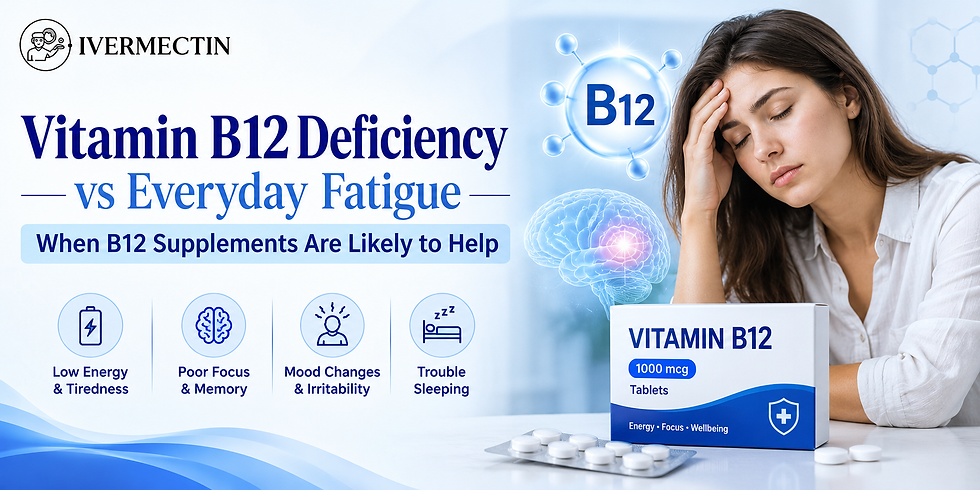
What is the difference between vitamin B12 deficiency vs fatigue?
Fatigue is a symptom; vitamin B12 deficiency is a nutritional or absorption-related condition that can cause fatigue. That means tiredness alone cannot tell you whether your B12 level is low.
Vitamin B12 is needed for healthy blood and nervous-system function. When deficiency interferes with normal red blood cell production, weakness and fatigue can develop. Deficiency can also affect nerves even when anaemia is not present.
Everyday fatigue is much broader. You might feel drained after poor sleep, prolonged stress, demanding work, inadequate food intake, an infection, or another health condition. If rest and routine changes improve your energy and there are no other concerning symptoms or risk factors, B12 deficiency becomes only one of many possibilities.
Vitamin B12 deficiency and everyday fatigue can overlap, but several clues may help distinguish them.
Feature | Possible B12 deficiency | Everyday fatigue |
Tiredness | Can be persistent and may occur with weakness | Common, often linked to sleep, stress or exertion |
Pins and needles or numbness | Can occur | Not typical of simple tiredness |
Sore or red tongue | Can occur | Not typical |
Pale appearance or palpitations | May accompany anaemia | Not expected from ordinary tiredness alone |
Balance or coordination changes | Can occur with neurological involvement | Not typical |
Clear B12 risk factors | Often increase suspicion | May be absent |
Response to rest | May not fully resolve the problem | Often improves when the trigger is temporary |
Blood testing | May identify biochemical deficiency | B12 results may be normal |
The symptoms in this table are clues rather than a diagnostic checklist. NHS guidance notes that B12 deficiency can cause tiredness, weakness, cognitive changes, pins and needles, numbness, muscle weakness, and balance or coordination problems.
B12 is not a general-purpose energy booster. Its strongest rationale for relieving fatigue is when B12 deficiency—or a meaningful risk of deficiency—is actually part of the problem.
Which symptoms make vitamin B12 deficiency more likely?
Fatigue becomes more suggestive of B12 deficiency when it occurs with compatible symptoms or recognised risk factors.
No single symptom confirms deficiency, and some people can develop neurological symptoms without having anaemia.
Possible signs include:
persistent weakness or unusual tiredness
numbness or pins and needles
problems with balance or coordination
a sore or red tongue
palpitations
pale skin
cognitive changes, such as problems with memory or concentration
These symptoms overlap with many other conditions, which is why self-diagnosing B12 deficiency from fatigue alone is unreliable.
Can you have B12 deficiency without anaemia?
Yes. Neurological problems associated with B12 deficiency can occur before or without the classic blood changes of megaloblastic anaemia. NIH guidance therefore emphasises that early recognition matters because prolonged neurological damage may become irreversible.
This is particularly important if tiredness appears alongside new numbness, tingling, balance problems, weakness, or cognitive changes.
Who is at higher risk of vitamin B12 deficiency?
Your likelihood of deficiency depends on much more than how tired you feel. Diet matters, but the ability to absorb B12 is equally important.
Higher-risk groups include older adults, people with pernicious anaemia or other causes of impaired B12 absorption, people with certain gastrointestinal disorders, those who have undergone stomach or intestinal surgery, and people eating diets that provide little or no reliable B12.
NICE also identifies medicines including metformin and proton pump inhibitors among factors that can increase the likelihood of low B12 concentrations.
Does a vegan or vegetarian diet increase B12 risk?
It can. Natural dietary B12 is primarily found in animal-derived foods, so people who avoid these foods need reliable fortified foods or another appropriate source of B12. NIH identifies vegetarian and especially vegan dietary patterns among situations in which deficiency risk deserves attention.
Common dietary sources of vitamin B12 and what they mean for deficiency risk.
Food pattern or source | B12 context |
Fish, meat and poultry | Natural sources of B12 |
Milk, yoghurt and cheese | Provide dietary B12 |
Eggs | Contain B12, although amounts vary |
Fortified cereals | Can provide B12 if the product is fortified |
Fortified nutritional yeast | Can provide substantial B12 depending on the product |
Unfortified plant foods | Generally should not be relied on as a natural B12 source |
NIH lists fish, meat, poultry, eggs, and dairy products as natural food sources and notes that some cereals and nutritional yeasts are fortified with B12.
How do you know whether fatigue is caused by low B12?
The most useful approach is to combine symptoms and risk factors with appropriate testing rather than judging from tiredness alone. A clinician may start with a blood test that measures B12 status and consider other laboratory findings or causes of fatigue depending on the situation.
Serum or plasma B12 is commonly used as an initial test. The NIH notes that values below approximately 200–250 pg/mL are generally considered subnormal, but interpretation is not always straightforward. When results are borderline, methylmalonic acid may sometimes help clarify B12 status, although kidney function and other factors can affect this marker.
Testing ranges and diagnostic approaches can differ between laboratories and healthcare systems, so a number should not be interpreted in isolation.
Why test before starting a supplement?
Testing can help determine whether B12 is actually a plausible explanation and may provide clues about why deficiency developed.
That distinction matters because simply replacing B12 does not necessarily address an underlying absorption problem, autoimmune condition, gastrointestinal disorder, medication-related issue, or another cause of fatigue. A clinician may also need to investigate other explanations if symptoms persist.
When are B12 supplements likely to help fatigue?
B12 replacement is most likely to help fatigue when vitamin B12 deficiency is present and the tiredness is related to that deficiency. The appropriate form and route depend on the cause and severity of deficiency, including whether B12 absorption is impaired.
For someone who already has adequate B12 status, taking extra B12 should not automatically be expected to produce more energy. A systematic review and meta-analysis of randomised trials examining people without overt B12 deficiency found no clear evidence that B12 supplementation improves idiopathic fatigue, although fatigue-specific evidence was limited.
In practical terms, supplementation has a clearer rationale when:
testing confirms or strongly supports deficiency
dietary intake is inadequate and B12 replacement is appropriate
a recognised medical or medication-related factor is affecting B12 status
a clinician recommends replacement based on symptoms, risk factors and test results
It has a weaker rationale as a stand-alone solution when tiredness appears to be related to insufficient sleep, stress, overwork, another untreated condition, or when B12 status is already adequate.
Does a higher-dose B12 supplement give you more energy?
Not necessarily. Supplements often contain far more B12 than the amount required each day, partly because absorption becomes proportionally lower as the oral dose rises.
A large number on a supplement label therefore does not mean it will produce a larger energy boost. Treatment doses used for diagnosed deficiency should also not be confused with routine nutritional intake.
What should you do if tiredness keeps coming back?
Persistent or unexplained fatigue deserves a broader look rather than repeated self-treatment with supplements. Consider whether there have been changes in sleep, stress, diet, physical activity, illness, medicines, menstrual blood loss, or other aspects of health.
If fatigue continues, interferes with normal activities, or occurs with other symptoms, medical evaluation can help identify whether B12 testing—or investigation for another cause—is appropriate.
A useful approach is to:
Notice how long the fatigue has lasted and whether rest improves it.
Review your diet and any known B12 risk factors.
Note neurological, digestive, cardiovascular, or other accompanying symptoms.
Tell your healthcare professional about medicines and supplements you use.
Avoid assuming that a vitamin deficiency is the cause before the evidence supports it.
When should fatigue or possible B12 deficiency get medical attention?
Seek medical assessment rather than relying only on an over-the-counter supplement if fatigue is persistent, worsening, unexplained, or affecting your usual activities. New numbness, pins and needles, muscle weakness, problems with balance or coordination, or cognitive changes also deserve timely evaluation because neurological problems can occur with B12 deficiency and may become harder to reverse when treatment is delayed.
Urgent medical care may be appropriate for severe shortness of breath, fainting, significant chest symptoms, rapidly worsening neurological problems, or other severe or sudden symptoms. These findings are not specific to B12 deficiency and may indicate another condition requiring prompt assessment.
Do not stop prescribed medicines simply because they may affect B12 status. Discuss possible medication-related deficiency and appropriate monitoring with the clinician managing your treatment.
Conclusion
Understanding vitamin B12 deficiency vs fatigue can prevent two common mistakes: overlooking a genuine deficiency and assuming every low-energy day needs a supplement. B12 replacement has the clearest role when deficiency or a significant risk of deficiency is established, while extra B12 is not a reliable solution for unexplained fatigue in people with adequate status. Pay attention to persistent tiredness, neurological symptoms, diet, medicines, and absorption-related risk factors rather than fatigue alone.
If your energy remains unusually low or you have symptoms suggesting B12 deficiency, discuss appropriate testing with a qualified healthcare professional. This article provides general education and does not replace individual medical assessment.


Frequently Asked Questions
1: Can low vitamin B12 make you tired?
Yes. Fatigue and weakness are recognised symptoms of vitamin B12 deficiency, particularly when deficiency affects normal blood formation. However, tiredness has many other causes, so fatigue by itself does not establish that your B12 level is low.
2: Will B12 supplements help if I am tired all the time?
They are most likely to help when B12 deficiency is contributing to your fatigue. Evidence does not show B12 to be a dependable energy treatment for people without overt deficiency. Persistent fatigue is therefore better evaluated than automatically treated with supplements.
3: How can I tell if tiredness is from B12 deficiency?
You usually cannot tell from fatigue alone. Symptoms such as pins and needles, numbness, balance problems or a sore tongue, together with dietary or absorption-related risk factors, can increase suspicion. Blood testing may then help determine whether deficiency is present.
4: Can you be vitamin B12 deficient even if you eat enough B12?
Yes. B12 deficiency can develop when the body cannot absorb enough vitamin B12 despite adequate dietary intake. Pernicious anaemia, gastrointestinal disease or surgery, and some long-term medicines can affect B12 absorption or status.
5: Can vitamin B12 deficiency cause symptoms without anaemia?
Yes. Neurological symptoms of B12 deficiency can occur even when anaemia has not developed. Numbness, tingling and balance or coordination problems deserve medical attention because delayed treatment of neurological B12 deficiency can sometimes lead to lasting damage.
6: Should I take B12 before having a blood test?
If deficiency is suspected, discuss testing and supplementation with a healthcare professional rather than relying on self-diagnosis. Tell them about supplements you already take because this information can matter when interpreting your B12 status and deciding whether further evaluation is needed.


Comments