
.png)
Fenbendazole vs Mebendazole: Key Differences Beyond Roundworm Treatment

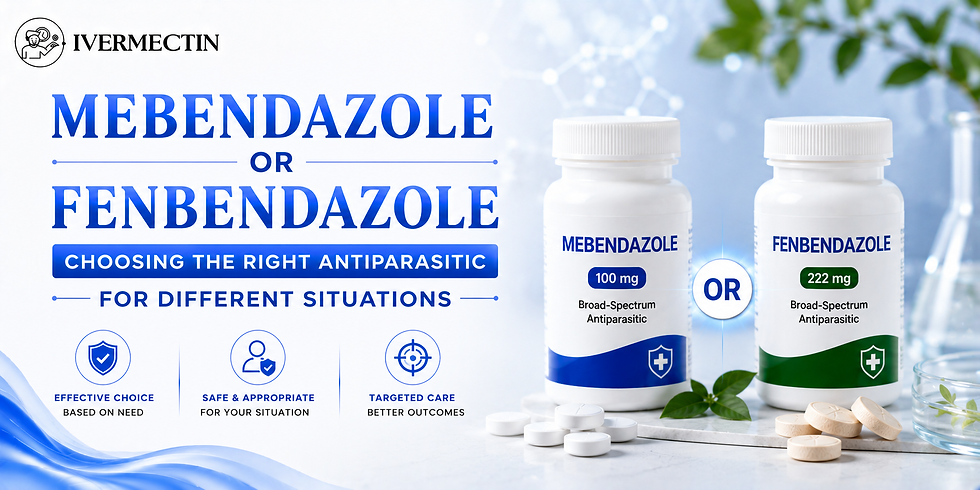
People researching antiparasitic medications often come across both Fenbendazole and Mebendazole . Because these medicines belong to the same drug family, it's easy to assume they work in exactly the same way. However, they differ in approved uses, availability, regulatory status, and the evidence supporting their use.
Take Ivermectin™, we believe patients should understand the facts behind commonly discussed medications rather than relying on online speculation. Learning how these medicines compare can help patients ask informed questions and better understand why healthcare providers recommend one treatment over another.
This guide explores the major differences between fenbendazole and mebendazole, explains how they work, and discusses why the correct medication always depends on an accurate diagnosis.

What Is Fenbendazole?
Fenbendazole is a benzimidazole antiparasitic medication primarily used in veterinary medicine to treat various parasitic worm infections in animals.
It works by disrupting the parasite's ability to absorb nutrients, eventually leading to its death.
Researchers continue to investigate fenbendazole in laboratory settings for a variety of scientific questions, but laboratory findings alone do not establish safety or effectiveness for human medical use.
What Is Mebendazole?
Mebendazole is a prescription antiparasitic medication approved in many countries for treating certain intestinal worm infections in humans.
Healthcare providers may prescribe it for infections caused by susceptible parasites such as:
Pinworms
Roundworms
Whipworms
Hookworms
Like all prescription medications, mebendazole should be used according to a healthcare provider's instructions.
How Do These Medications Work?
Both medications belong to the benzimidazole class and share a similar basic mechanism of action.
They interfere with the parasite's ability to absorb glucose, reducing its energy supply and preventing normal growth and survival.
Although their mechanisms are similar, this does not mean they are interchangeable for every patient or every condition.
Treatment recommendations depend on factors such as:
Type of parasite
Patient age
Medical history
Approved indications
Safety considerations
Key Differences Beyond Roundworm Treatment
Many people associate both medications with roundworm treatment, but there are several important differences.
Intended Use
Fenbendazole is primarily formulated for veterinary use, while mebendazole is approved for specific human
parasitic infections in many countries.
Regulatory Approval
The regulatory status of these medications differs depending on the country and intended use.
Clinical Evidence
Mebendazole has substantial clinical evidence supporting its approved human uses. Research involving fenbendazole for other potential applications remains an area of scientific investigation.
Availability
Mebendazole is generally available through prescription or approved healthcare channels, while fenbendazole products are commonly marketed for veterinary purposes.
Side-by-Side Comparison
Feature | Fenbendazole | Mebendazole |
Drug Class | Benzimidazole | Benzimidazole |
Primary Use | Veterinary antiparasitic | Human antiparasitic |
Human Approval | Varies by country and indication | Approved for certain human parasitic infections in many regions |
Prescription Status | Depends on product and country | Often prescription-based or regulated |
Medical Supervision | Recommended | Essential |
Why Proper Diagnosis Matters
Many intestinal parasites can cause similar symptoms, including abdominal discomfort, diarrhea, nausea, and fatigue.
However, different parasites respond to different medications.
Choosing treatment based only on symptoms or internet advice may result in:
Incorrect medication
Delayed diagnosis
Persistent infection
Unnecessary side effects
Missed underlying medical conditions
A healthcare provider can recommend appropriate testing before selecting treatment.
Can These Medications Be Used Interchangeably?
Although fenbendazole and mebendazole belong to the same medication family, they should not be considered interchangeable without medical guidance.
Differences in:
Approved indications
Available formulations
Dosing recommendations
Safety information
Clinical evidence
mean that treatment decisions should always be individualized.
Safety Considerations
Whether prescribed for humans or used in veterinary medicine, medications should always be taken only as directed and for their intended purpose.
Important Medication Safety considerations include:
Never use medication without a proper diagnosis.
Follow the prescribed dose and treatment schedule.
Inform your healthcare provider about all medications and supplements you take.
Report any unusual or severe side effects promptly.
Never substitute one medication for another without professional advice.
Even medications within the same drug class can have different approved uses, dosing recommendations, and safety profiles.
Common Misconceptions
Because fenbendazole and mebendazole belong to the same family of medications, several misconceptions have developed online.
1: They Are Exactly the Same
Fact: While they share a similar mechanism of action, they differ in approved uses, formulations, and available clinical evidence.
2: One Can Always Replace the Other
Fact: Treatment depends on the specific parasite, the patient's health, and medical guidance. They should not be considered interchangeable.
3: Online Testimonials Are Scientific Proof
Fact: Personal experiences cannot replace well-designed clinical research when evaluating the safety and effectiveness of any medication.
4: Higher Doses Work Better
Fact: Taking more medication than prescribed increases the risk of side effects without guaranteeing better results.
Questions to Ask Your Healthcare Provider
If you have questions about antiparasitic treatment, consider discussing the following with your healthcare provider:
Which parasite has been identified?
Why is this medication recommended?
What side effects should I watch for?
Are follow-up tests necessary?
Could this medication interact with my other prescriptions?
What should I do if my symptoms continue after treatment?
Having an informed conversation with your healthcare provider can help ensure that your treatment is both safe and appropriate.
The Importance of Accurate Diagnosis
Many parasitic infections can cause similar symptoms, making it difficult to identify the cause without proper testing.
Depending on the suspected infection, a healthcare provider may recommend:
Stool testing
Blood tests
Imaging studies (when appropriate)
Physical examination
Review of travel and exposure history
An accurate diagnosis helps ensure the most appropriate treatment is selected while reducing the risk of unnecessary medication use.
Future Research on Benzimidazole Medications
Researchers continue to study benzimidazole medications to better understand their potential applications and improve treatment options.
Current areas of research include:
New antiparasitic therapies
Drug resistance
Improved formulations
Combination treatment strategies
Expanded understanding of parasite biology
As scientific evidence grows, treatment recommendations may continue to evolve based on new clinical data.
Evidence-Based Treatment Matters
Evidence-based medicine combines high-quality scientific research with clinical expertise and patient needs.
This approach helps healthcare providers:
Choose appropriate medications.
Evaluate treatment risks and benefits.
Monitor patient safety.
Update recommendations as new evidence becomes available.
Patients should always rely on qualified healthcare professionals rather than online speculation when making treatment decisions.
"Two medications may belong to the same drug family, but that doesn't mean they have the same approved uses or the same level of clinical evidence."
Conclusion
Although fenbendazole and mebendazole belong to the same benzimidazole family, they differ in approved uses, regulatory status, clinical evidence, and availability. These differences are important and help explain why one medication cannot automatically replace the other.
Choosing the right antiparasitic treatment requires an accurate diagnosis, professional medical guidance, and consideration of each patient's individual health needs. Understanding these differences allows patients to have more informed conversations with their healthcare providers and make safer healthcare decisions.
Take Ivermectin™ , our mission is to provide clear, balanced, and evidence-based educational content that helps readers better understand medications and make informed decisions alongside qualified healthcare professionals.


Frequently Asked Questions (FAQs)
1. Are fenbendazole and mebendazole the same medication?
No. Although they belong to the same drug class, they have different approved uses, formulations, and regulatory status.
2. Can fenbendazole replace mebendazole?
Not without medical guidance. Treatment decisions should always be based on the diagnosed condition, available evidence, and healthcare provider recommendations.
3. What infections is mebendazole commonly used to treat?
Mebendazole is commonly prescribed for certain intestinal worm infections, including pinworms, roundworms, whipworms, and hookworms, depending on local medical guidelines.
4. Why do people compare fenbendazole and mebendazole?
People often compare them because both belong to the benzimidazole class of antiparasitic medications and have similar mechanisms of action, even though their approved uses differ.
5. Is laboratory research enough to prove a medication works for humans?
No. Laboratory studies are only one step in the research process. Human clinical trials are needed to evaluate safety and effectiveness.
6. Why is medical supervision important when taking antiparasitic medications?
Healthcare providers ensure the correct diagnosis, appropriate medication selection, proper dosing, and monitoring for side effects or treatment response.
Comments